Focus on Light and Color in Real World Art
The Elements of Art: Colour
Course Level: 1–2
Students will be introduced to ane of the basic elements of art—color—through analysis of works of art past Monet, Matisse, and Kandinsky. Class discussion focused on these paintings will assist students understand how artists utilize color to convey atmosphere and mood. They will then test their color expertise by completing a downloadable worksheet and coloring a photograph of Rouen Cathedral.
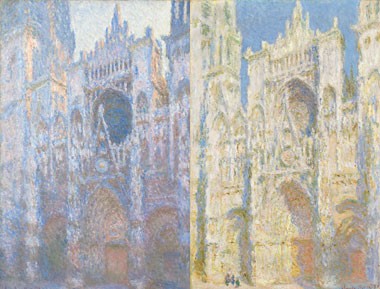
Left:
Claude Monet
French, 1840–1926
Rouen Cathedral, W Façade, 1894
oil on canvas, 100.1 x 65.ix cm (39 iii/8 10 25 15/sixteen in.)
National Gallery of Art, Chester Dale Collection
Correct:
Claude Monet
French, 1840–1926
Rouen Cathedral, Due west Façade, Sunlight, 1894
oil on canvas, 100.one x 65.8 cm (39 three/eight x 25 vii/eight in.) National Gallery of Art, Chester Dale Drove
Curriculum Connections
- Science
- Language Arts
Materials
- Smart Board or computer with ability to project images from slideshow
- Writing materials
- Oil pastels or crayons
- Copies of the "Colorful Language" worksheet and faded prototype of Rouen Cathedral
- Hot glue
- 11 x xiv newspaper
- Watercolors and brushes
Warm-up Questions
Are these paintings of the aforementioned building? How are they similar and unlike?
Background
Color is what we see considering of reflected light. Lite contains different wavelengths of free energy that our eyes and brain "encounter" as different colors. When light hits an object, we see the colored light that reflects off the object.
Cherry, blue, and xanthous are the primary colors. With paints of just these three colors, artists can mix them to create all the other colors. When artists mix pigments of the primary colors, they brand secondary colors.
Red + Blueish = Purple
Red + Yellow = Orange
Blueish + Yellow = Green
Did you lot know that your computer screen also works by using three master colors? Just hither, since the colors are calorie-free from the monitor and not paints, the three primaries are not the same. Instead, your computer screen mixes other colors from ruddy, blue, and light-green.
One important thing painters know: using complementary colors—the ones across from each other on the color wheel (ruby-red-greenish, blueish-orange, and yellow-purple)—make both colors seem brighter and more intense. They seem to vibrate and pop out at you, the viewer.
Warm colors—reds, yellows, oranges, and red-violets—are those of burn and the sun. They appear to project. Cool colors—blues, blueish-greens, and blue-violets—are those of ice and the bounding main. They appear to recede.
Guided Practice
To go students thinking about colour and the moods or feelings that colors can convey, read a book that focuses on color, such as The 24-hour interval the Crayons Quit by Drew Daywalt.
Then view the slideshow below to introduce students to three artists—Claude Monet, Henri Matisse, and Wassily Kandinsky—and the manner they used color in their paintings.
Slideshow: Monet, Matisse, and Kandinsky on Color


French creative person Claude Monet liked to paint the same subject over and over once more, at dissimilar times of day and in different types of weather. He painted Rouen cathedral in French republic some thirty times, merely what fascinated him most was not the edifice—it was, he said, the surrounding temper. Rather than quick studies of irresolute light furnishings, these pictures, slowly reworked in the studio, are carefully considered explorations of color and mood:
- Each painting uses Rouen Cathedral to record time (morning time or late afternoon) and weather (sunlight or mist). Examine the manner Monet used color and texture: Tin can y'all tell from the shadows in the doorways which painting might have been done in the morning time and which in the afternoon? (Don't forget that the sun rises in the e and these paintings show the west façade or front of the building.) How do the colors change in sunlight, fog, and mist?
- Do you meet any clear outlines? Is it possible to determine exactly where one surface ends and another begins? If line does not define the forms in this painting, what does? (Reply: colour!)
Effectually 1905 several artists, including Matisse, exhibited pictures in which heightened color was used to express a stiff emotional response to nature. The painters were called "fauves," or wild beasts. The freshness and strength of the tones in Open Window, Collioure are typical of the fauves; Matisse's contrasts are subtle, giving this work a sense of serenity and radiance. Bear witness students this painting (second to last epitome in the slideshow) to respond the following questions:
- Would you rather go sailing or stay in your absurd room admiring the view?
- Depict the colors. How are they different from what you see in nature? What color would you usually utilize to color the sea? Have you always seen a pink sea? (Perhaps if it's reflecting a sunset…)
- How big exercise you think this painting is? Information technology's actually only 21 3/4 ten eighteen one/8 inches. See how Matisse transformed the effect of a minor canvas into expansive pictorial space through the device of the open window and eye-popping colour.
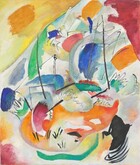
Wassily Kandinsky, raised in Odessa, Russia, learned to play the cello and piano as a child. As an artist, he drew connections betwixt art and music and believed that colors and shapes could affect our mood. Show students Improvisation 31 (Sea Battle) (concluding paradigm in the slideshow) without revealing the name of the championship:
- What colors exercise you run into in this painting? What do the colors in this painting make you lot feel? happy? sad? scared?
- What practice you lot call back is happening in this painting?
- Afterwards students accept hypothesized what the scene depicts, let them know the title contains the phrase "ocean battle." Now accept them clarify the painting: Can you lot find ii tall-masted ships locked in combat? Can they spot any canon fire? What is the sea like that 24-hour interval? The weather?
Activity
Download a faded version of the photograph of the due west façade of Rouen Cathedral in Paris that Monet painted at all time of mean solar day and in all types of weather (the original photo is the first image in the slideshow). Students will select a time of day and type of weather condition so color over this faded image using advisable hues in oil pastel (preferable to cover paradigm, but crayons could also be used).
As an alternative that can adjust students with visual impairments, print out a larger version of the images on 11 x xiv paper. Trace the lines of each image with hot glue to create a raised surface that students can feel. Then give students a evidently slice of paper to lay over the epitome outlined in hot glue. Students can then create a texture rubbing with crayon over the newspaper. Every bit a final footstep the students can paint over the crayon rubbing with watercolors.
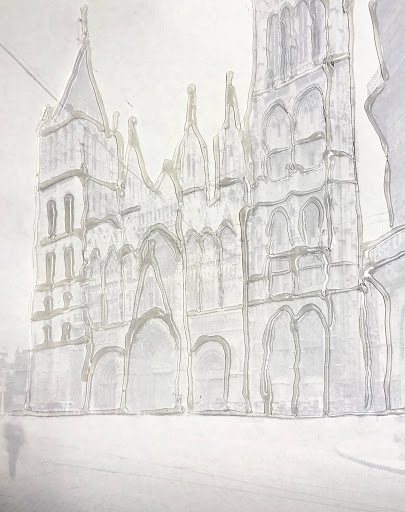
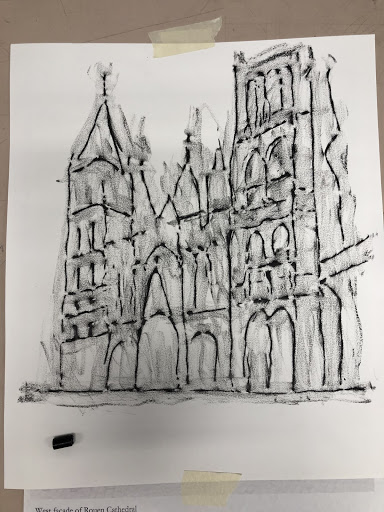
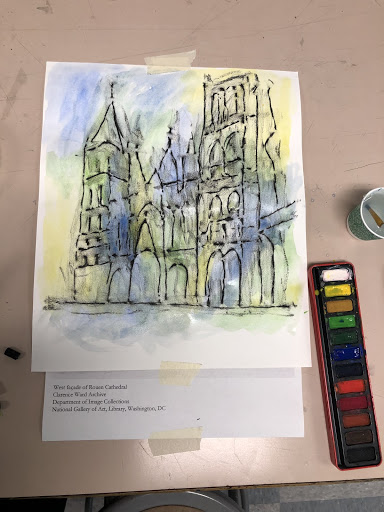
On a printed version of the epitome, trace the lines with hot glue to create a raised surface that students can feel.
Extension
Now that students have investigated various uses of color in 3 artists' works, they will fill out the "Colorful Linguistic communication" worksheet to test their knowledge of color. Adjacent, students will select one work of fine art from the slideshow as if information technology were a postcard of somewhere they visited. They will then write a short alphabetic character to a friend or family member describing what they saw, what fourth dimension of mean solar day it was, and what the weather condition was like using the colors from the work of fine art every bit their guide.
The Elements of Art is supported by the Robert Lehman Foundation
National Core Arts Standards
VA:Cr2.1.1 Explore uses of materials and tools to create works of art or design.
VA:Cr2.2.aneDemonstrate safe and proper procedures for using materials, tools, and equipment while making fine art.
VA:Cr3.1.1 Utilise fine art vocabulary to draw choices while creating fine art.
VA:Re7.1.ii Perceive and draw aesthetic characteristics of one'south natural earth and synthetic environments.
VA:Re7.2.1 Compare images that represent the same subject.
VA:Re8.i.2 Translate art by identifying the mood suggested by a work of art and describing relevant subject area matter and characteristics of form.
VA:Re9.one.2 Utilize learned fine art vocabulary to express preferences about artwork.
Source: https://www.nga.gov/learn/teachers/lessons-activities/elements-of-art/color.html

إرسال تعليق for "Focus on Light and Color in Real World Art"